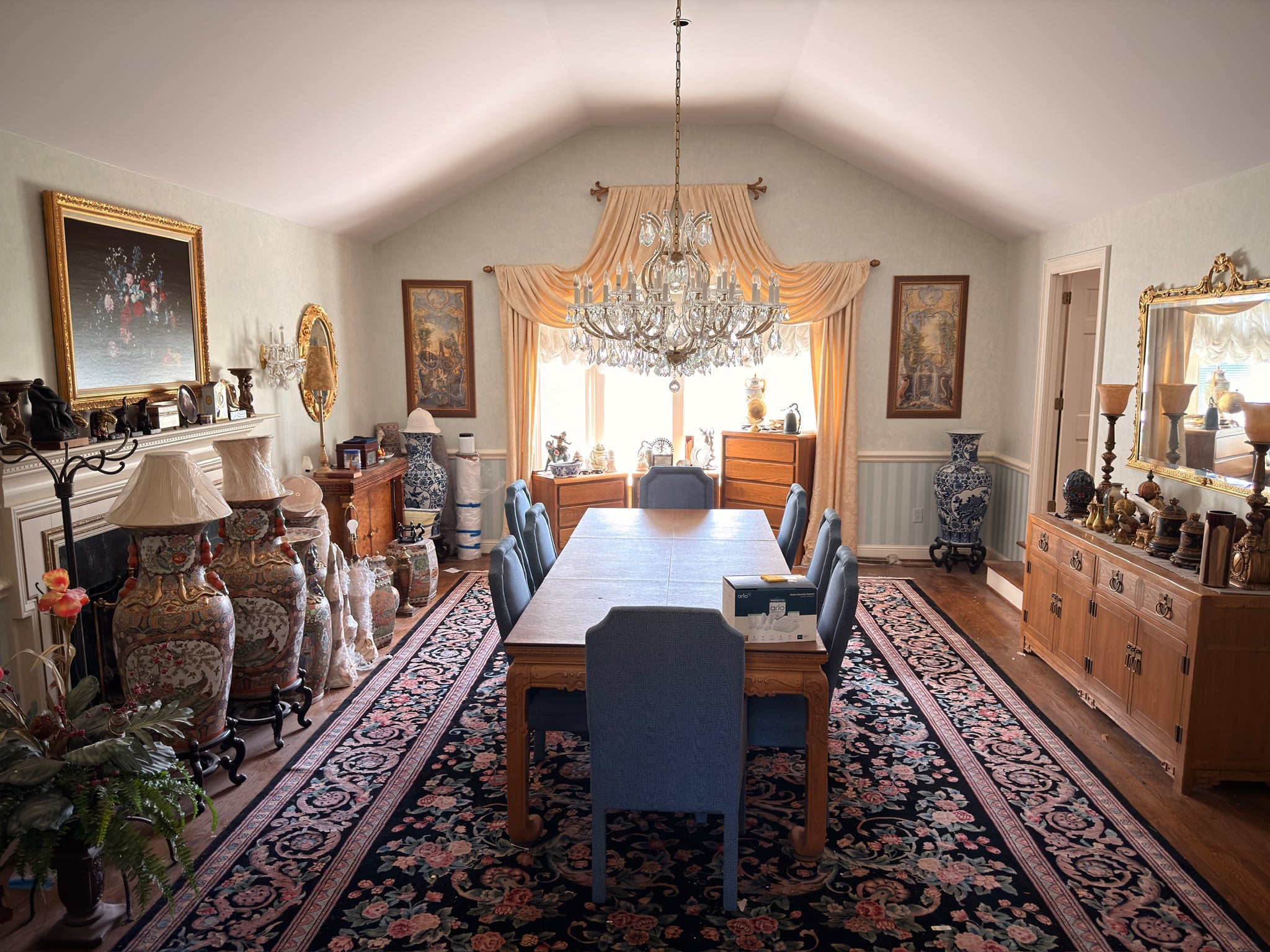
Most families downsizing a family home plan the move first and deal with the contents afterward. That order costs money. You pay to move furniture that will not fit the next house, then pay again to store it or get rid of it once you find out.
Running the estate sale first reverses that. You sell what is not going with you while it is still in the rooms it belongs in, and you move a shorter load into the new place. Below is how to sequence the two, what the sale can realistically do, and where sellers tend to misjudge what their contents are worth.

Why the sale comes before the move
Movers price by volume and weight. Every piece you sell beforehand is a line removed from that estimate, and a decision you do not have to make again in a smaller house.
Staging is the other reason. A dining set reads as a dining set when it is standing in a dining room with the china behind it. The same furniture pushed into a garage or a storage unit is harder to photograph, harder to sell, and harder for a buyer to picture at home.
Timing matters more than most people expect. The sale itself runs over a few days. The work around it, walkthrough, research, pricing, staging, photography, and promotion, is what needs runway. Reach out once you have a target date in mind, even a rough one, rather than waiting until you are under contract. Our complete downsizing guide lays out the full timeline working backward from your deadline.
Decide what you are keeping
Measure the rooms, closets, and storage in the next home before you mark anything. Most of the hard calls answer themselves once you know the actual square footage you are working with. AARP's guide to decluttering before a move is a useful starting point if you have not begun.
Mark what is going with you and set family keepsakes aside, ideally in one room you can close. Then walk the garage, attic, basement, and closets. Tools, kitchenware, yard equipment, books, linens, and holiday decorations belong in the sale alongside the furniture, and those rooms are the ones sellers forget.
You do not need to organize, clean, or price anything first. Leave the contents where they are so our team can see them together. If you are keeping part of a collection, say so before the walkthrough, because what stays and what goes changes how we group and price the rest.
Where sellers misjudge the value
This is the part families are least prepared for, so it is worth saying plainly.
Large formal furniture usually brings less than owners expect. Full dining suites, china cabinets, entertainment centers, and upright pianos are hard to move and fit fewer homes than they did when they were bought. The buyer pool for them is narrow, whatever the piece originally cost.
The everyday contents carry more of the sale than people assume. Kitchen goods, hand and power tools, garage and yard equipment, small tables and chairs, linens, and seasonal decorations move steadily because buyers use them. Garages and kitchens often account for more of a sale total than the formal rooms do.
Jewelry, coins, sterling flatware, quality art, and specialized collections are worth identifying before anything leaves the house. These are the categories where research changes the number, and where a piece sold off early to a buyer at the door tends to go for less than it would have at a priced, promoted sale.
One more thing: age and value are separate questions. Condition, completeness, and current demand set the price. A common pattern in Nashville homes is that the item the family assumed was the centerpiece is not, and something in the basement is.

Plan for what does not sell
No sale clears a house to zero. Decide up front what happens to the remainder, and get it in writing before the sale, not after.
Some items you may want returned to you. Others may qualify for donation, which depends on what the receiving organization will accept and when they can collect. Anything left after that becomes a removal question, and cleanout and removal work is arranged and priced separately from the sale. Sorting this out during the walkthrough keeps it from becoming a problem the week you are trying to close on a house.
How fees and proceeds work
Estate Greats charges no upfront fees. The company is paid a commission out of what the sale brings, which means the sale has to perform for us to be paid.
Your net proceeds are the sale total minus the agreed commission and any expenses you approved in advance. What a sale brings depends on the contents, their condition, demand, and how much time there is to prepare. Settlement is issued within 14 days of the final sale of all goods and completion of remaining item removal, along with an itemized record of every transaction.
When you are comparing companies, ask what the commission covers and what is billed on top of it. Those two answers explain most of the difference between quotes. Our guide to estate sale commission and costs covers what to compare before you sign anything. If you are also weighing the tax side of selling a long-held home, Kiplinger has a useful overview of the rules.

What our team handles, and what stays with you
Estate Greats handles research, pricing, staging, photography, promotion, sale-day staffing, and checkout across Nashville and Middle Tennessee. You receive an itemized sales report when the sale closes out.
Packing, moving, and the relocation itself stay with you and whoever you hire for them. We work around that schedule rather than replacing it.
Tell us early about HOA rules, parking limits, gate codes, or rooms that are still in use, since all of those shape how a sale is run. If a sale at the house is impractical, whether because of access, restrictions, or timing, we can look at whether our Berry Hill offsite venue fits the contents and the date you need to be out.
Common questions about downsizing sales
Should I hold the estate sale before or after I move?
Before, in most cases. Selling while the contents are still in place means you are not paying to move items you intend to sell, and furniture shows better staged in the rooms it was used in than in a garage or storage unit.
Do I need to clean out or organize before the walkthrough?
No. Leave the contents as they are. Set aside anything not for sale, ideally in one room that can be closed off, and let our team assess the rest in place. Sorting and discarding beforehand is where value most often gets lost.
What happens to items that do not sell?
That is agreed before the sale. Items can be returned to you, offered for donation depending on what the receiving organization accepts, or included in a cleanout. Removal work is arranged and priced separately from the sale.
When do I get paid after the sale?
Settlement is issued within 14 days of the final sale of all goods and completion of remaining item removal, with an itemized record of the transactions.
Do I owe Tennessee sales tax on what my estate sale brings?
Estate Greats does not collect sales tax on these sales. Personal property sold on behalf of a third party is exempt under Tennessee law at Tenn. Code Ann. § 67-6-102(8). Your own tax situation on the sale of a home is a separate question for your accountant.
Start with a walkthrough
Bring us in while the house is still full and you still have options on the date. Contact us for a free consultation and tell us what you are selling, where it is, and when you need to be out. There is no cost and no obligation for the walkthrough.