
17 questions before you hire.
Compare estate sale companies on fees, insurance, staffing, and settlement. Read our answers to all 17 questions, or print the checklist for your consultations.
Select a question to read why it matters and our answer.
Money and terms
The commission rate on its own tells you almost nothing. What matters is the rate plus everything charged underneath it, and when the money actually reaches you.
What is your commission?
Industry commissions generally run in the 30–50% range depending on the size and complexity of the sale. A low headline rate with fees stacked underneath it can easily cost more than a higher all‑in rate, so never take this number by itself — always ask question 2 in the same breath.
Our standard commission is 40% of gross sales, agreed with you in writing before we begin. There is no upfront cost to you.
That covers setup and staging, research and pricing, photography, advertising, a fully staffed sale, checkout and cash handling, and settlement with an itemized report. The industry range is typically 30–50%.
When comparing companies, looking at the commission and any separate fees together will help you understand the total cost. We explain our additional services in question 2 below.
For a closer look at what is included, see our full cost breakdown: Are estate sale companies worth the commission?
Are there any fees besides the commission?
This is where companies differ the most, and where surprises show up on the final settlement. Ask specifically about each of these: advertising and photography, labor or staffing charges, dumpster and haul‑away, credit card processing, moving heavy or oversized items, cleaning, and any minimum. Ask for the answer in writing.
There are no upfront fees, consultation fees, listing fees, or setup charges. Our compensation is the agreed commission on gross sales, paid from the sale proceeds.
Our commission covers all estate sale services, including preparation, unboxing, retrieval of sale items from storage, research, pricing, staging, photography, marketing and paid advertising, labor, staffing, checkout, and itemized reporting. There are no extra fees for these services.
Removal of leftover items after the sale is optional and carries an additional fee, quoted separately and approved by you before work begins.
Do you charge sales tax?
In Tennessee this is not a matter of company preference. It turns on a specific rule about whether the company discloses who owns the property it is selling, and the answer changes who owes the tax — you or them. Ask any company you interview what their basis is. A clear, specific answer in either direction is fine. A shrug means nobody has looked, and on your sale that is a question you inherit.
No — we do not charge sales tax on the household contents of your sale. Here is how Tennessee’s rules apply to the household estate sales we handle.
Under Tennessee’s agent rule (Tenn. Comp. R. & Regs. 1320‑05‑01‑.01), when a company sells property for a disclosed owner, the sale is taxable to that owner rather than to the company. Separately, under Tenn. Code Ann. § 67‑6‑102(8)(B), occasional and isolated sales by someone not regularly engaged in business fall outside the definition of “business” altogether — which is exactly what an estate, or a family downsizing, is.
The Tennessee Department of Revenue explains how these rules work together in its guidance for auctioneers and consignees: where the principal is disclosed, sales tax does not apply to an estate sale, because the estate is not engaged in business. Where the principal is not disclosed, the company running the sale is deemed the owner, and the sale becomes taxable.
We disclose the owner when handling your sale, which is part of qualifying for this exemption.
Motor vehicles are an exception to this exemption: a title transfer is taxable on its own terms regardless of the rest of the sale. If your sale involves a business liquidation, dealer inventory, or a trust with its own filings, your CPA or the estate’s attorney can help confirm the tax treatment for your situation.
Every transaction runs through Square at checkout either way, so each sale produces a complete, auditable record of what sold and for how much.
How long after the sale will I be paid?
Reputable companies commit to a specific window and hand you an itemized report showing what sold and at what price. “As soon as we get everything counted” is not an answer. Ask for the number of days, and ask whether the report is itemized or just a total.
A check is mailed within five business days of the sale ending, along with a detailed, itemized sales report.
Your report lists each item sold and its selling price, so you can see how the sale went and review the results at your own pace.
We know you may be settling an estate or preparing for a closing, and getting your proceeds to you promptly is an important part of our service.
Trust and protection
You are handing a stranger the keys to a house and everything in it. These four questions are the ones that protect you, and they are the ones most people forget to ask.
Do you have insurance? What types?
Hundreds of strangers are about to walk through a property you own or are responsible for as executor. If someone is injured, or something is damaged, the company’s coverage should answer for it — not your homeowner’s policy, and not your personal liability as an executor. Ask for a certificate of insurance. A verbal “yes, we’re insured” is not a certificate.
Yes, Estate Greats is bonded and insured. We carry general liability insurance for injury and property damage arising from the sale, along with workers’ compensation for our team.
These coverages are an important part of caring for your home and the people working in it throughout the sale.
Do you have a written contract? Can I review it before I sign?
Most consultations happen at your kitchen table, and a company that wants a signature at that first visit — before you have had a copy in your hands — has told you something important. Ask for a copy to keep, and when you read it, go straight to five things: the commission rate, the complete fee list, what condition the home will be left in, what happens to unsold items, and how either side cancels.
Yes. Your written contract is available in your client portal, where you can read it before signing and return to it throughout our work together.
Please take the time you need to review it, and feel free to share it with your attorney, executor, or family. Our estate executor guide also explains what to look for before signing.
We are happy to walk through any questions with you. We want you to feel comfortable with the agreement before moving forward.
Do you pre-sell items or allow early entry?
This question protects your bottom line. If the best pieces are sold to dealers or insiders before the doors open, the public sale is picked over on day one, foot traffic drops, and so does your total. Ask it directly and listen for hedging.
We do not offer shopper presales or early entry. All shoppers enter at the published opening time and shop on the same terms, including dealers and people we know.
Staff may set items aside during setup under our written purchasing policy, and those items are paid for at full price. Question 8 explains the safeguards. If you prefer to have no staff purchases at your sale, we are happy to honor that.
Do you or your employees buy items from the sale?
This is the single most important conflict‑of‑interest question on the list, and the one companies are vaguest about. Anyone who both prices an item and is allowed to buy it has a direct financial incentive to price it low. A yes or no answer is not enough — ask to see the written policy.
Yes, in limited circumstances, with a written staff purchasing policy designed to protect your interests. Here is how it works:
- Staff do not price their own purchases. The owner or general manager prices anything a team member intends to buy, even if that team member is helping with pricing that day.
- Items set aside during setup are paid for at full price. Sale-day markdowns do not apply to items reserved before the sale opens.
- Every purchase requires a paid ticket. Staff purchases go through Square just like customer purchases. Our policy treats taking an item without a paid ticket as theft and grounds for immediate termination. We also support a homeowner who chooses to file a report.
- New team members wait 60 days before they may set items aside.
- You can choose to have no staff purchases. Just let us know, and we will reserve shopping for customers at your sale.
We are happy to explain the policy and answer any questions. A written policy is also a helpful point to compare when you are speaking with other companies.
The people and the expertise
Two companies can charge the same commission and produce wildly different totals. The difference is almost always who is pricing the items and how many people are working the floor.
Do you have an appraiser on staff, or access to one?
The gap between a $40 sticker and a $4,000 sale is entirely a matter of knowing what you are looking at. Ask who does the pricing, what their training is, and — just as important — what happens when something turns up that nobody on the team recognizes.
Yes. Peter Cole is our certified appraiser, and every team member is trained in appraisal methodology. Our team knows when an item needs a closer look and can bring it to Peter for review.
We combine current market research, condition, and comparable completed sales with years of experience selling to Nashville estate sale customers. What buyers have actually paid and which categories sell well help us set opening prices. We aim for the highest realistic price with a strong chance of selling on the first day, before scheduled discounts. High-value or unfamiliar pieces receive closer individual research.
What is your field of expertise?
Every company has a center of gravity — antiques, mid‑century, art, tools, jewelry, or simply moving volume quickly. If your estate is concentrated in one category, you want a company that has sold that category before and knows who buys it.
Our expertise includes fine furniture, antiques, art, jewelry, and collectibles, along with the everyday household items that are part of most estates.
Presentation is a particular strength of ours. We thoughtfully stage each home to create a welcoming shopping experience and help buyers see the appeal of the items throughout it.
How many people will staff a sale like mine?
Understaffing costs you money twice: items walk out unpaid, and buyers abandon a long checkout line with full arms. Ask for a number for a home your size, not a general answer, and ask how checkout and cash are handled.
We plan staffing around the size of your home, the amount being sold, and the crowd we expect, with a minimum of two staff on site at all times. Larger sales receive a larger team, and we discuss the staffing planned for your sale at the consultation.
Our team covers every preparation day and sale day. During the sale, we handle crowd flow, floor coverage, checkout, negotiation, and customer service.
Cash drawers are counted and logged before opening and at closing, and every transaction runs through Square.
The schedule
If there is a closing date, a move‑out date, or a probate deadline in play, these three questions decide whether a company is actually an option for you.
How many days do you think it will take to set up?
Setup time tells you two things at once: how thorough the company intends to be, and how long the house is unavailable to you. Be wary in both directions — a company promising to set up a full house in a single day is either bringing a large crew or cutting corners, and it is fair to ask which.
We prepare your sale in three phases: setup, when we sort, stage, and organize your home; pricing, when we research, tag, and log items; and sale days.
A typical estate needs about two days of setup and one to two days of pricing. We usually begin on Monday or Tuesday, finish preparation by Thursday, and open the sale on Friday. Your home is generally in use for three to four days before opening.
Larger or more complex estates may need extra time, which we plan with you in advance. You will know the schedule before we begin. From the first consultation to the completed sale, the process typically takes one to two weeks.
How many days will the sale itself be?
Sale length affects your total. Too short and you miss buyers; too long and you are discounting to an empty house. Ask about the markdown schedule too — when prices drop, and by how much — because that schedule determines what your last day is worth.
A typical sale runs Friday through Sunday, with Saturday usually our busiest day. Depending on the size of the estate, a sale may run from two to four days.
We publish the discount schedule so shoppers know what to expect: day one is full price, day two is 30% off, and day three is 50% off.
We also consider reasonable offers throughout the sale. Accepting a good offer early can bring you a better return than waiting for a later discount, and we keep your interests in mind when negotiating.
When would you be able to do the sale?
Ask for specific dates, not a season. Good companies book out, and the honest ones will tell you plainly when they cannot meet your deadline. If your timeline is driven by a closing or a move‑out date, put that on the table at the consultation rather than discovering the conflict later.
We discuss available dates at your consultation, which is free and carries no obligation.
If you have a closing date or another deadline in mind, please share it with us. We will talk through what is possible and whether we can give your sale the time and attention it needs within your schedule.
After the sale
What happens once the last buyer leaves is the part families think about least and regret most. Settle it before you sign, not after.
How will my home be left? Broom clean, empty, or as‑is?
“Broom clean,” “empty,” and “as‑is” are three very different outcomes, and the difference can be thousands of dollars and several days of your time. Whatever a company promises verbally, get the exact end condition written into the contract.
We will talk through how you would like the home left and include the agreed condition in your contract before we begin. Whether you are preparing to list the house or keeping it in the family, we can help you plan for the next step.
A full clean-out to move-ready condition is available as an add-on. For unsold items, you can choose donation to a local charity, re-consignment through our offsite location, disposal, or return to you.
Do you have a store?
A company with its own retail store has somewhere to move inventory that did not sell, which can work in your favor. But it also creates a question worth asking directly: if unsold items go to their store, who owns them at that point, how are they priced, and do you share in what they bring?
We have a 2,500 sq ft event space on West Iris Drive in Berry Hill, where we host offsite estate sales. It operates as a sale venue rather than a retail store.
It can be a helpful option if an at-home sale is difficult because of HOA or gated community rules, home showings, privacy preferences, or an upcoming closing. We collect your items, stage and price them at the event space, and handle the sale there.
If you would like unsold items re-consigned through the space, we agree on the terms with you in writing beforehand.
The one that tells you the most
Do you have any sales coming up that I could visit?
This is the most useful question on the entire list, and almost nobody asks it. Go stand in a sale that company is actually running. Look at the signage, the staging, whether the house feels organized or ransacked, how long the checkout line is, how the staff speak to shoppers, and whether items are priced or randomly guessed at. Fifteen minutes in a live sale will tell you more than an hour of conversation in your living room.
Yes, we would love for you to visit. You can find addresses and times on our upcoming sales page.
Feel free to stop by whenever it suits you during sale hours. There is no need to arrange a visit or introduce yourself. Browse at your own pace, see how we set up and run a sale, and get a feel for whether we are the right fit for your family.
Seven answers that should give you pause
What are red flags at estate sales? When you are hiring an estate sale company, red flags include an unclear commission, a contract you cannot review, surprise fees, no proof of insurance, a vague payment timeline, no sale you can visit, and pressure to sign immediately.
None of these is proof of a bad company on its own. But each one is worth slowing down for, and two or more together is a pattern.
“I’d have to check on the commission”
Every company knows its own rate. Not naming it usually means it depends on how much they think you will accept.
You can’t take the contract home
There is no legitimate reason to keep a contract from the person being asked to sign it.
“We’ll sort out the fees later”
Fees settled after the sale are settled without your leverage. Get the complete list before you sign.
No certificate of insurance
“We’re insured” is a sentence. A certificate is a document. Ask for the document.
A vague payment timeline
If nobody will commit to a number of days, you have no recourse when it takes six weeks.
No sale you can visit
An established company has upcoming sales. If there is nothing to see, ask why.
Pressure to sign today
“This date will go to someone else” is a sales tactic. A good company will still be there on Thursday.
Take the checklist with you
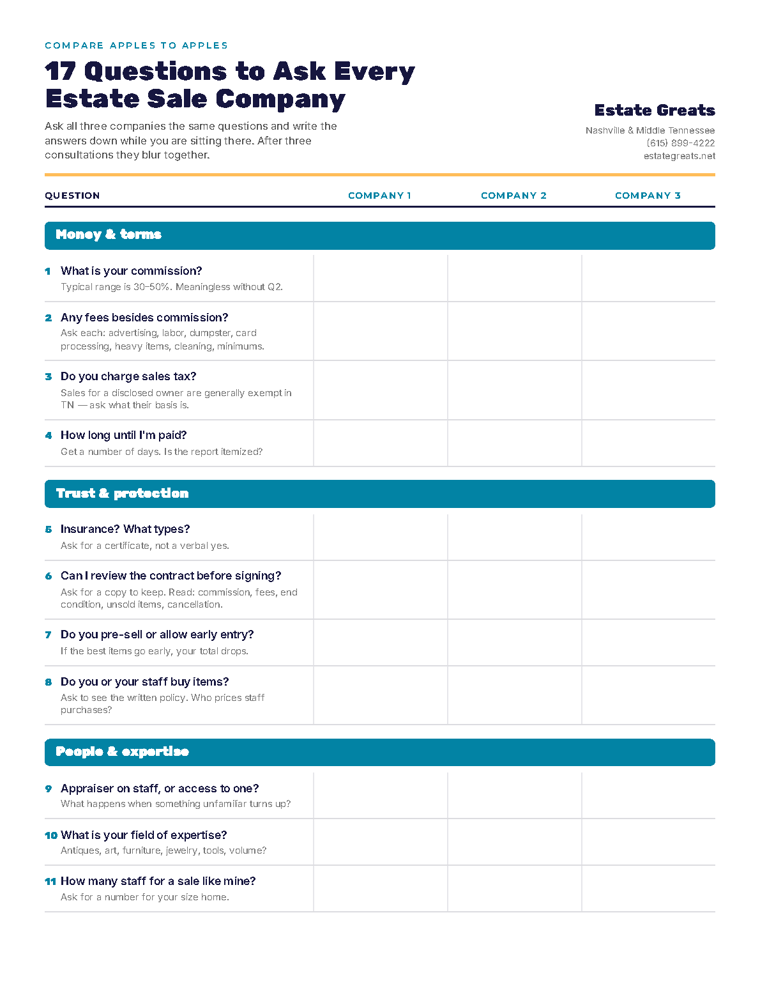
A one‑page printable version of all 17 questions, with space to record three companies’ answers side by side. Bring it to every consultation, fill it in while you are sitting there, and compare them properly afterward.
This list is adapted from the questions EstateSales.NET suggests families ask when choosing an estate sale company — rewritten in our own words, with our answers added. They also suggest you mention if you found a company through their site, which we would echo — it is a genuinely useful resource, and our sales are listed there alongside everyone else’s.